On March 19, 2026, Algonquin Highlands council sat down to consider a routine-sounding item: a bylaw to close and convey a strip of shoreline in front of Lot 21, Concession 4, in the geographic Township of Stanhope. The land in question was an original shore road allowance, a 66-foot ribbon the Crown carved out along the water more than a century ago. The owner of the abutting cottage had applied to buy it, the way hundreds of Haliburton County property owners have before them. What made this filing worth noticing wasn't the transaction itself. It was the timing.
That meeting happened less than three months after Algonquin Highlands began actively enforcing a policy that changes what it means to own waterfront in parts of Haliburton County. If you're buying, selling, or already holding a cottage on a lake here, the shore road allowance question just moved from a line item your lawyer handles quietly to something worth understanding before you sign anything.
What You Might Not Actually Own
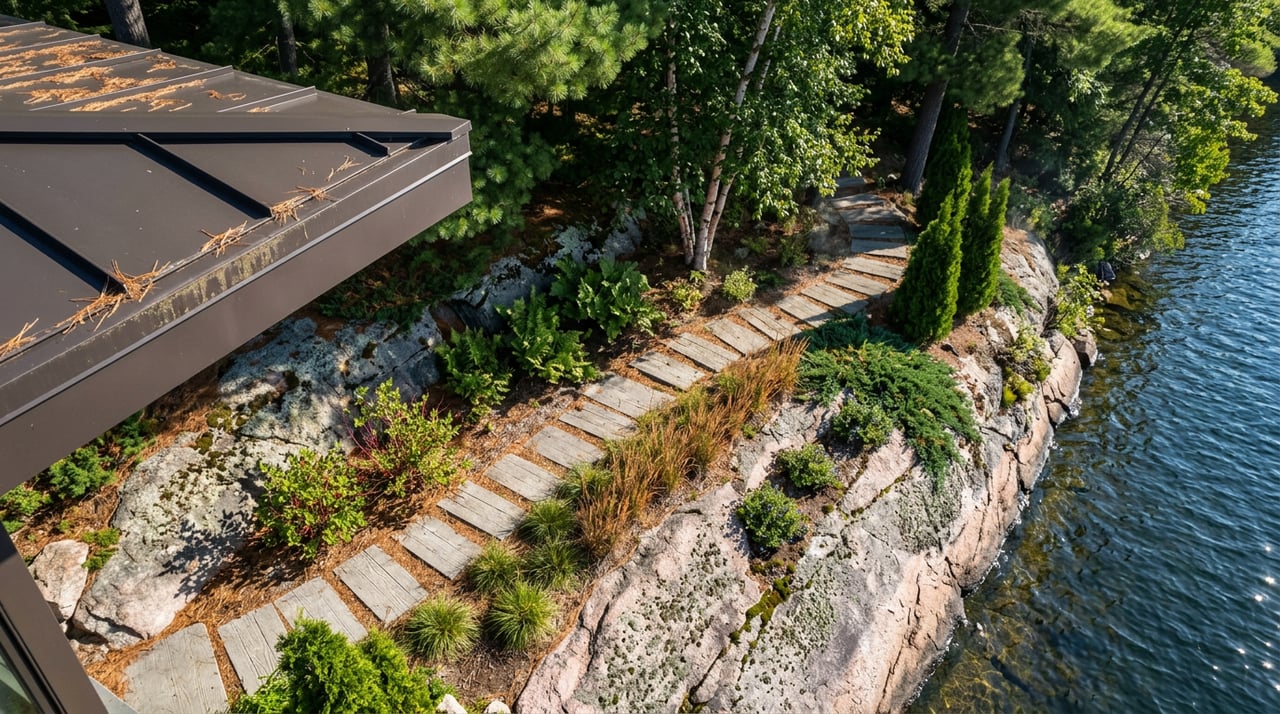
A shore road allowance, often shortened to SRA, is a strip of land between a waterfront lot and the water itself, usually 66 feet or about 20 metres wide. Crown surveyors laid these out in the mid to late 1800s so logging crews and travelers could reach the shore before roads existed. The logging stopped generations ago. The allowances didn't disappear. Unless a property owner formally purchased and closed theirs, it still belongs to the local municipality, not to whoever built the cottage behind it.
Anthony vanLieshout, a realtor with Royal LePage Lakes of Haliburton, put a number on how common this is in an interview with Cottage Life: "In Haliburton County, probably eighty-five per cent of people do not own their shore road allowance." Read that again. The overwhelming majority of waterfront owners in this county do not hold clear title to the ground between their cottage and the lake. For decades that gap sat quietly. It rarely stopped anyone from swimming off their own dock. It has, however, occasionally stopped a bank from approving a mortgage or an insurer from writing a policy without extra paperwork, because technically the dock, the boathouse, or even part of the cottage can be sitting on land the buyer doesn't own.
Why Algonquin Highlands Started Enforcing This in 2026
The bylaw behind the Stanhope closure isn't new. Algonquin Highlands passed its License of Occupation Policy under By-law 2023-98 in November 2023, and it took effect January 1, 2024. What changed is enforcement. Council made the policy retroactive, against its own planner's advice, and gave itself the authority to issue removal orders for non-complying structures starting January 1, 2026. That date has now passed. The grace period is over.
The policy applies to a specific and narrower situation than most people assume: it only covers properties where a township-maintained road runs between the cottage and the water, separating the two. If your shore road allowance sits directly against your property with no road in between, Algonquin Highlands has said explicitly it has no plans to change how that's handled.
That distinction isn't arbitrary, and understanding why reveals the actual logic driving this. The township's own planner explained the reasoning during public consultation: the Municipal Act requires municipalities to keep a highway in a state of repair, and gives municipalities legal defenses if they didn't know about a hazard on that highway. Once a township-maintained road exists between a private cottage and the water, the shore road allowance on the far side of that road starts to look, legally, like an extension of the road itself. That's a liability exposure the township didn't have before someone built a dock or a set of stairs on it. The License of Occupation isn't primarily a revenue tool. It's a liability transfer, priced at a $2 million minimum public liability insurance policy that license holders must carry annually for the ten-year term. Roughly 250 to 350 properties across Algonquin Highlands fall into this category, according to the township's own estimate.
There's a tax wrinkle too. The Municipal Property Assessment Corporation assesses these road-separated properties as waterfront, with what the township describes as an adjustment to reflect the reduced access. In plain terms, some owners already pay something close to a waterfront rate for a property that, until they sign a license, doesn't legally include the shoreline.
When the Township's Own Paperwork Gets Challenged
Not everyone affected by the policy is accepting the township's claim to the land at face value. A group called HC Voices, formed by affected property owners around Halls Lake and Maple Lake, has spent recent years digging through the original land registry, historical surveys, and GIS records looking for gaps in the township's ownership position.
What they found complicates the picture considerably. Halls Lake and several nearby lakes were dammed and flooded to support logging operations in the 1800s, which raises the question of whether the current shoreline is even where the original 1860s survey placed it. On Maple Lake, a deed and survey tied to a North Shore Road property reportedly showed the original shoreline sitting 40 feet from where the water sits today. The group also flagged a road allowance that currently intersects a point of land at Walls Lane on Maple Lake that, according to the 1860 survey notes, didn't touch that point at all. HC Voices has since commissioned its own survey to test whether the original shore road allowance is actually underwater, which would mean the road the township maintains is what's known as a forced road rather than the allowance itself.
None of this has been resolved. What it demonstrates is worth sitting with regardless of how the dispute ends: even the party enforcing shore road allowance claims doesn't always have a clean, undisputed answer about where the line falls. That should temper anyone's confidence in assuming a listing's shoreline is exactly what the deed implies.
What This Costs and How Long It Takes
For owners who decide to purchase and close their shore road allowance rather than license it, the process runs through the local municipality rather than the province, and the mechanics are fairly consistent across Haliburton County's townships.
| Step | What It Involves |
|---|---|
| Application | Submitted to the township with a deposit toward legal, survey, and advertising costs; portions of the deposit are non-refundable once council review begins |
| Survey | A current survey prepared by an Ontario Land Surveyor, showing the allowance and any existing structures |
| Public notice | The township advertises the closure locally and circulates it to neighbouring landowners for objection |
| Council decision | Council can approve, deny, or require modifications, particularly if the closure would block another owner's access |
| Cost | Calculated per square foot of the allowance, plus HST, on top of legal and survey fees |
| Timeline | Municipalities generally advise applicants to allow about one year to complete a purchase |
Owners who choose to license rather than close, under Algonquin Highlands' specific policy, take on the ten-year insurance and compliance obligations instead of a purchase price, and can only replace existing stairs, docks, and pump houses with a building permit. Everything else on the licensed strip has to stay in whatever condition it was in when the bylaw passed.
What This Means Before You Write an Offer
If you're evaluating a waterfront property anywhere in Haliburton County this year, a few questions are worth asking before conditions come off.
- Does the property's deed show the shore road allowance as already closed and merged into the lot, or is it still separate?
- Is there a township-maintained road between the cottage and the water? If so, ask specifically whether a License of Occupation applies and whether the current owner has one in place.
- Has the seller's structure, dock, or boathouse ever been flagged as sitting partly on unowned municipal land, and does that show up in any survey on file?
- Does your lender or insurer have a policy on financing or insuring a structure that encroaches on a shore road allowance that hasn't been closed?
For sellers, the practical move is to gather whatever survey and title documentation already exists well before listing. Given the one-year timeline municipalities cite for closures, starting that conversation with the township early, rather than after an accepted offer, keeps the allowance question from becoming a closing-week surprise.
A Few Questions Worth Asking Directly
Does this affect Muskoka too, or is it a Haliburton-only issue? Shore road allowances exist across most of Ontario's cottage country, including Muskoka, Parry Sound, and the Kawarthas, wherever Crown surveyors laid out shoreline lots in the 1800s. Algonquin Highlands' retroactive enforcement is specific to that township, but similar License of Occupation bylaws already exist in Dysart et al, Highlands East, Minden Hills, Lake of Bays, and Muskoka, without the same retroactive enforcement date.
If I buy a cottage where the seller never closed the SRA, does that become my problem? Generally yes. The allowance status attaches to the land, not the person, so an unresolved shore road allowance passes to the next owner unless it's addressed before or at closing.
Does owning the shore road allowance change what I can build? It can. Some townships base maximum cottage size on a percentage of total lot area, so adding a closed allowance to your property can expand what you're permitted to build, subject to the same setback and zoning rules that apply to the rest of the lot.
Buying waterfront in Haliburton County has always meant buying into the Canadian Shield's particular version of ownership, where the lake, the granite, and the paperwork all shape what a property actually is. The shore road allowance question isn't a reason to walk away from a good property. It's a reason to ask the right question before you're the one explaining it to a bank, an insurer, or the next buyer.
If you're weighing a waterfront purchase or sale in Haliburton County and want a clear-eyed read on what a specific property's shoreline status actually means for financing, resale, and long-term use, Birchwood Real Estate can walk through it with you. Get My Valuation to see where your property or search stands before you write the next offer.